Why Does Boiler Keep Losing Pressure?
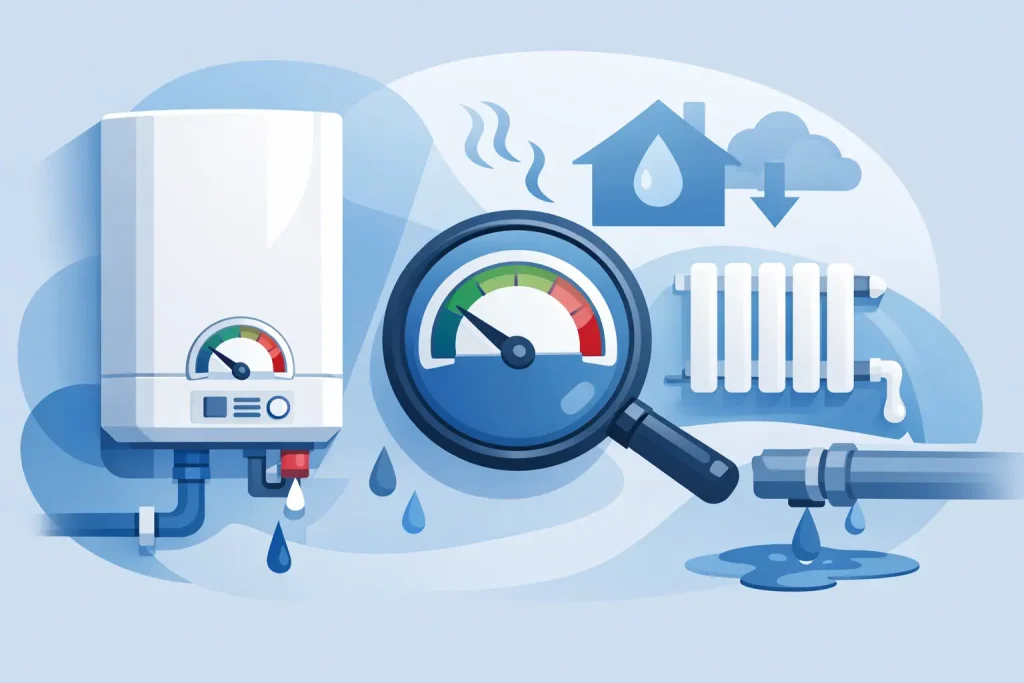
You notice that the pressure gauge has dropped again, the heating is not working as it should, and now you are wondering why the boiler keeps losing pressure in the first place. It is a common fault in homes across West Lothian, and while topping the pressure back up may get things running again temporarily, repeated pressure loss usually means something in the system needs attention.
A sealed heating system should hold its pressure reasonably well. Small changes between hot and cold are normal, but if the gauge keeps falling and you are regularly using the filling loop, that is not something to ignore. In many cases the cause is straightforward. In others, it points to a fault that needs proper diagnosis before it turns into a breakdown or water damage.
Why does a boiler keep losing pressure?
There is no single answer because pressure can be lost in a few different ways. The key point is that water is either escaping from the heating system somewhere, or the boiler is no longer managing pressure correctly internally.
The most common causes include a leak on the system, a problem with the pressure relief valve, an issue with the expansion vessel, or bleeding radiators without topping the system back up properly. Less often, the fault can sit inside the boiler itself, where it is not immediately visible to the homeowner.
What matters is the pattern. A very slow pressure drop over months can suggest one sort of issue. A pressure loss every few days, or a gauge that falls to zero quickly, suggests another. That is why a proper inspection is always better than guessing.
A hidden leak somewhere on the heating system
A water leak is one of the most common reasons why a boiler keeps losing pressure. Sometimes it is obvious, such as a dripping radiator valve, a damp patch near pipework, or staining on ceilings below upstairs radiators. But many leaks are slow and easy to miss.
Pipework can run under floors, behind boxing, or through cupboards where small drips go unnoticed for a long time. Even a minor leak can steadily reduce system pressure. In some homes, the first sign is not a puddle but cold radiators, repeated pressure loss, or corrosion around valves and joints.
If you suspect a leak, look around radiator tails, lockshield valves, TRVs, and visible pipe joints. Check for green deposits, rust marks, dried water staining, or flooring that feels slightly warped. You do not need a major burst for pressure to fall. A very slow leak is enough.
The expansion vessel may have lost its charge
Inside many modern boilers there is an expansion vessel. Its job is to allow for the natural expansion of water as the system heats up. If that vessel loses its air charge or the internal diaphragm fails, the pressure can behave erratically.
A common sign is a gauge that rises too high when the heating is on, then drops low when the system cools. In some cases, the boiler may discharge water through the safety valve when hot. Once that water has escaped, the pressure falls and the boiler needs topping up again.
This is not usually something a homeowner can diagnose with certainty just by looking at the front of the boiler. It needs testing properly. If left unresolved, it tends to keep repeating because repressurising the system does not correct the vessel fault itself.
The pressure relief valve could be passing water
The pressure relief valve is a safety device designed to release water if the system pressure gets too high. It protects the boiler and system from overpressure. But once it has lifted, sometimes it does not reseat cleanly and can continue letting water escape slowly.
That water often discharges through a copper pipe on the outside wall. Because it goes outside, many people do not realise it is happening. You may have no visible leak indoors, yet the system pressure still drops.
If there is dripping from the discharge pipe outside, that is a sign worth checking. It does not always mean the valve itself is the only fault, because an expansion vessel problem can be what caused it to open in the first place. The point is that pressure loss and discharge pipe drips often go hand in hand.
Bleeding radiators can lower pressure too
If you have recently bled radiators, that may be part of the answer. Releasing trapped air also releases some pressure from the sealed system. A small drop afterwards is normal, and the boiler may simply need repressurising once.
What is not normal is needing to bleed radiators repeatedly because they keep filling with air, or finding that pressure drops again soon after topping up. Persistent air in the system can point to an underlying leak, poor system condition, or another fault drawing air in over time.
If your radiators are cold at the top and you are bleeding them often, it is worth getting the wider system checked rather than just repeating the same routine.
Why does the boiler keep losing pressure after topping up?
If the pressure comes back briefly and then drops again, topping up is treating the symptom rather than the cause. The filling loop only adds water back into the system. It does not stop leaks, repair valves, or correct internal component faults.
Using the filling loop too often is not a good habit. Fresh water introduced repeatedly into the heating system can add oxygen and contribute to internal corrosion over time. That can shorten the life of radiators, valves, pumps, and heat exchangers.
So if you are asking why the boiler keeps losing pressure after you have already topped it up once or twice, the honest answer is usually that the original fault is still there and needs to be found properly.
What you can check safely at home
There are a few sensible checks you can make before booking a repair. Look at the boiler pressure gauge when the system is cold, then again after the heating has been on for a while. If the pressure rises sharply when hot and falls right back when cold, that can help point towards an expansion-related issue.
Check around visible radiators and valves for drips or staining. Look outside for water coming from the pressure relief discharge pipe. If you have recently bled radiators, think about whether the pressure loss started after that or whether it was happening already.
You can also check whether the filling loop valves have been left slightly open by mistake, although any work beyond simple visual checks should be left alone. If you are unsure, it is always better to stop and ask.
When to call a Gas Safe engineer
If the pressure keeps falling, the boiler locks out, there are visible leaks, or you are having to top it up more than occasionally, it is time to get it looked at. Pressure loss is often fixable, but accurate diagnosis matters. Replacing the wrong part wastes time and money.
A proper visit should go beyond resetting the boiler and adding water. The system needs checking methodically, including the boiler components, visible heating pipework, radiator valves, discharge pipe, and overall system behaviour under operation. That is especially important in homes where the fault seems intermittent or there are signs of poor past maintenance.
For landlords, repeated pressure issues should also be dealt with promptly. Tenants should not be left with unreliable heating or hot water, and pressure faults can develop into bigger repairs if ignored.
Can low pressure damage the boiler?
Low pressure itself does not always cause immediate damage, but it can stop the boiler operating properly and can be a sign of a fault that will get worse. Many boilers will lock out for safety if the pressure falls too low. That protects the appliance, but it still leaves you without heating or hot water until the issue is sorted.
The bigger risk comes from what is causing the pressure loss. Ongoing leaks can damage property. Repeated topping up can affect system condition. And faults such as failed vessels or passing valves rarely improve on their own.
That is why we do not cut corners when investigating this type of issue. A careful, thorough check is the best way to stop a recurring problem becoming a more expensive one.
If your boiler keeps losing pressure, the safest approach is to treat it as an early warning sign rather than a minor nuisance. A steady, well-maintained heating system should not need constant attention, and getting the cause identified early usually means a simpler fix and less disruption at home.