
How to Spot Boiler Short Cycling
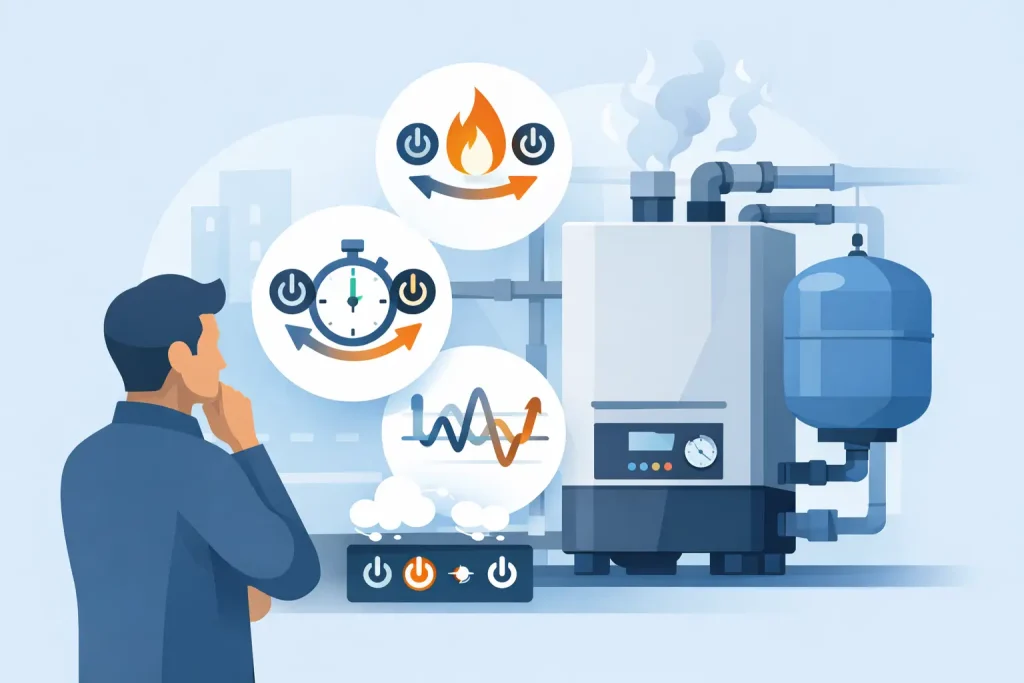
If your boiler keeps firing up, switching off, then starting again a few minutes later, that is not just a quirk you can ignore. Knowing how to spot boiler short cycling early can save you from higher gas bills, uneven heating, and a repair that gets more expensive the longer it is left.
Short cycling means the boiler is turning on and off too frequently instead of completing a proper heating cycle. In a healthy system, the boiler should run steadily for a period, bring the water up to temperature, then switch off as intended. When it starts cutting in and out every few minutes, something is usually not right.
For homeowners and landlords, the difficulty is that short cycling does not always look dramatic at first. The heating may still work. You may still have hot water. But the boiler is working harder than it should, and that extra strain can shorten the life of key components.
How to spot boiler short cycling at home
The most obvious sign is the pattern of operation. You hear the boiler fire up, run briefly, shut down, and then restart again soon after. This can happen several times within a short period, even when there is still a demand for heating.
Another common clue is room temperature that never seems quite steady. The house warms up in bursts rather than consistently. Radiators may get hot, then cool off, then heat up again before the room ever feels properly comfortable.
You might also notice your gas usage creeping up without a clear reason. A boiler uses more energy during ignition and start-up than it does when it is running normally. If it is repeatedly starting and stopping, efficiency drops.
Some households first notice it through noise. More frequent clicking, fan noise, ignition sounds, or the boiler repeatedly coming to life can all point to cycling issues. On some modern boilers, there may also be fault codes or lockouts if the problem gets worse.
What short cycling feels like in day-to-day use
It often shows up as a collection of small annoyances rather than one obvious failure. Hot water may fluctuate more than usual. The heating may seem to respond poorly to thermostat changes. Certain rooms may feel cooler, especially if the system is struggling with circulation.
Landlords sometimes hear about it from tenants as “the boiler keeps coming on and off” or “the heating never seems to settle”. Homeowners often describe it as the boiler sounding busy all the time without delivering the comfort they expect.
That matters because short cycling is not just about efficiency. It can be a sign of overheating, poor water flow, control faults, or an appliance that is not matched properly to the system.
Common causes of boiler short cycling
There is no single cause in every property. That is why proper diagnosis matters.
A common issue is restricted water flow. If the heat the boiler creates cannot move away properly through the system, the boiler temperature rises too quickly and the appliance shuts itself down. Sludge in the system, a blocked filter, partially closed valves, or a weak pump can all contribute.
An overpowered boiler can also short cycle. If the boiler output is too high for the property’s heat demand, especially in milder weather, it can satisfy the call for heat too quickly and then switch off, only to start again soon after. This is more noticeable in smaller homes or systems with limited radiator capacity.
Thermostat or control problems are another possibility. If the thermostat is poorly located, faulty, or sending inconsistent signals, the boiler may cycle unnecessarily. Smart controls can help when set up well, but poor programming or incorrect settings can create stop-start behaviour too.
On combination boilers, plate heat exchanger issues, sensor faults, or limescale build-up can also play a part. In hard water areas, scale can reduce heat transfer and affect how the boiler reads and responds to temperature.
Then there is simple lack of maintenance. A boiler that has not been properly serviced may have dirty internal components, blocked condensate pathways, worn sensors, or combustion issues that affect performance. This is where a detailed service makes a real difference. We do not cut corners because rushed checks often miss the early signs.
How to tell short cycling from normal boiler operation
Not every on-off pattern is a fault. Modern condensing boilers are designed to modulate, meaning they adjust their output depending on demand. At certain times, especially when the house is nearly up to temperature, some variation in operation is expected.
The concern is when the boiler runs for very short periods repeatedly, particularly from cold, or when it cannot maintain a steady cycle even though the heating is clearly still needed. If it is firing for a minute or two, shutting down, then doing the same again over and over, that is not normal operation.
It also depends on the season. On a mild spring day, a boiler may naturally run less. On a cold West Lothian morning, with several radiators calling for heat, it should not be constantly bouncing in and out unless something is wrong.
A few checks you can do safely
Before booking a repair, there are a few basic things you can look at without taking covers off or attempting anything internal.
Check that your thermostat is set sensibly and actually calling for heat. If you have smart controls, make sure there is no unusual scheduling or conflicting temperature setting causing rapid demands.
Look at the system pressure if you have a sealed system boiler or combi. Low pressure can affect operation, though repeated pressure loss points to a deeper problem that needs attention.
Feel whether your radiators are heating evenly. If some stay cool at the bottom or heat very patchily, circulation problems or sludge may be involved. Also check that radiator valves are open where heat is needed.
If you have a magnetic filter fitted, consider when the system was last serviced properly. A blocked or neglected filter can affect flow. What you should not do is remove boiler covers, reset the appliance repeatedly, or keep running it in the hope the issue disappears.
When short cycling becomes a repair issue
If the boiler is locking out, making unusual noises, failing to heat the home properly, or showing recurring fault codes, it is time to get it checked. The same applies if you have already ruled out simple control settings and the problem continues.
Short cycling can lead to wear on fans, ignition components, pumps, and printed circuit boards. It can also mask safety-related faults or overheating issues that should never be guessed at. A Gas Safe engineer can test temperatures, flow rates, combustion performance, controls, and component behaviour properly rather than replacing parts blindly.
For landlords, there is also the practical side. Leaving a cycling boiler unresolved increases the chance of a breakdown call later, often at the worst possible time. Preventative attention is usually cheaper and less disruptive than waiting for total failure.
How a proper engineer diagnoses boiler short cycling
A thorough diagnosis goes beyond watching the boiler fire a few times. The engineer should look at the wider heating system, not just the appliance in isolation.
That means checking operating temperatures, pump performance, filter condition, system cleanliness, pressure stability, controls, sensors, and whether the boiler is sized and set up appropriately for the property. On some visits, the issue turns out to be straightforward. On others, there are several smaller faults combining to create the same symptom.
This is exactly why detailed servicing matters. If a service only covers the bare minimum, early circulation or control problems can easily be missed. A more careful inspection gives you a much better chance of catching wear, build-up, or poor system health before it develops into breakdown territory.
Can boiler short cycling be prevented?
Often, yes. Regular servicing is the main defence, especially when it includes internal cleaning, safety checks, combustion testing, and inspection of system condition rather than a quick once-over. Keeping filters clean, dealing with sludge, and making sure controls are set up properly all help the boiler run in longer, healthier cycles.
It is also worth reviewing the heating system as a whole. If radiators have been removed, extensions added, or controls upgraded over time, the original setup may no longer suit the property perfectly. What worked years ago may now be causing inefficiency or unstable operation.
If you are not sure whether what you are hearing is normal, trust the pattern rather than waiting for a full breakdown. A boiler that is repeatedly starting and stopping is telling you something. Catch it early, get it checked properly, and you stand a much better chance of keeping your home safe, warm, and free of avoidable repair costs.