
What Is Checked on a Gas Boiler Service?
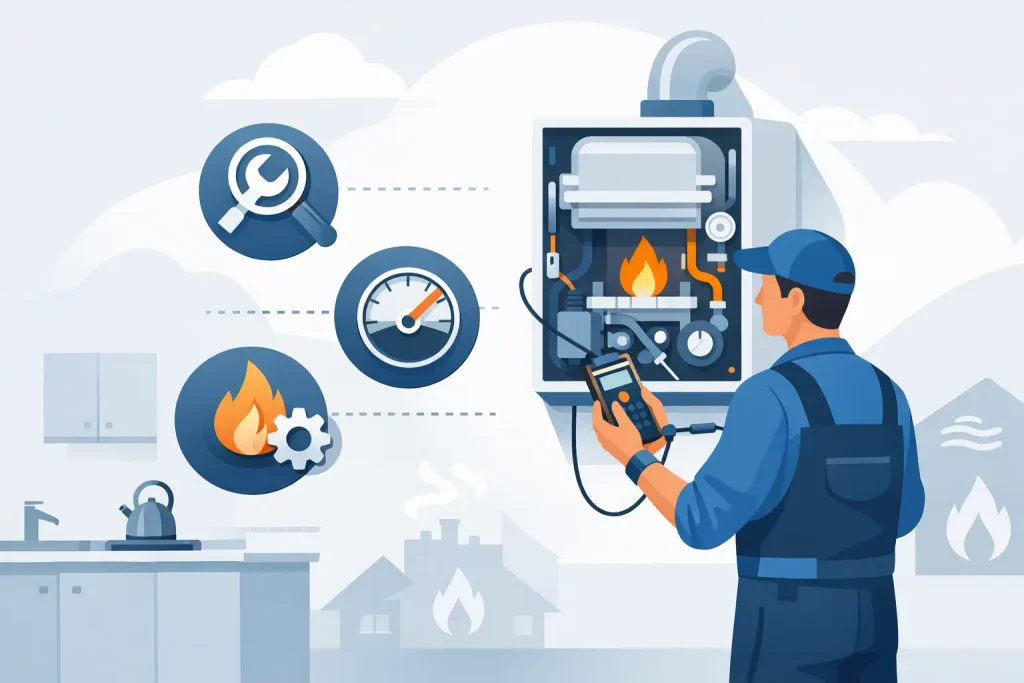
A boiler service should never feel like someone simply turns up, looks at the casing for ten minutes, and leaves. If you are paying for a proper visit, you should know exactly what is checked on a petrol boiler service and why those checks matter to your safety, heating performance, and long-term repair costs.
For many homeowners and landlords, the problem is not knowing what a good service looks like. Boilers often keep running even when parts are dirty, worn, or starting to drift out of spec. That is why a thorough service is about far more than ticking a box. It is a chance to spot faults early, keep the appliance working efficiently, and make sure it is operating safely.
What is checked on a petrol boiler service?
The exact detail depends on the make, model, age, and condition of the boiler, along with the manufacturer’s instructions. But a proper petrol boiler service usually includes safety checks, performance testing, internal inspection, cleaning of key components where required, and a wider look at the heating system.
That matters because two boilers can look fine from the outside and behave very differently internally. One may be clean, correctly adjusted, and running safely. The other may have early signs of combustion issues, sludge in the system, poor circulation, or seals beginning to deteriorate.
Safety checks come first
Any competent boiler service starts with basic but essential safety checks. The engineer will inspect the boiler location, check that it is installed safely, and confirm there are no obvious issues with ventilation, damage, or signs of distress around the appliance.
The petrol supply is checked to make sure the appliance is receiving the correct pressure and that there are no signs of leaks. Tightness testing may be carried out where appropriate to confirm the pipework is sound. If the petrol rate is tested, this helps show whether the boiler is burning the right amount of petrol for its designed output.
The flue is another key part of the service. This is the component that carries combustion gases safely outside. If the flue is damaged, poorly sealed, blocked, or incorrectly fitted, dangerous fumes could spill back into the property. During a service, the flue route, condition, support, and termination are checked, along with signs of corrosion, poor joints, or staining.
Combustion and emissions testing
One of the most important parts of a modern boiler service is analysing combustion. Using a flue petrol analyser, the engineer checks how the boiler is burning fuel. This gives readings for combustion efficiency and helps identify whether the air-to-petrol mix is correct.
If those readings are outside the expected range, it can point to faults such as blocked burners, poor combustion, fan issues, or flue problems. This is not something you can judge by listening to the boiler or seeing whether the radiators still get warm. A boiler can appear to be working normally and still need attention.
Internal boiler checks and cleaning
A proper service should involve more than external inspection. Depending on the appliance and what the manufacturer allows, the boiler casing is removed so internal components can be checked. This is where the difference between a basic visit and a thorough service often becomes clear.
Inside the boiler, the engineer may inspect the main heat exchanger, burner, ignition components, seals, and combustion chamber. Dust, debris, and combustion residues can build up over time. If left alone, that build-up can affect efficiency, ignition reliability, and safe operation.
Where needed, components are cleaned carefully in line with manufacturer guidance. On some boilers, this includes cleaning the condensate trap, checking and cleaning the burner, or inspecting the electrodes. These are not glamorous tasks, but they are often the difference between a boiler that keeps running reliably and one that starts locking out in the middle of winter.
At Boiler-Serv, that more detailed approach is a big part of the service. We do not cut corners, and that matters because internal checks are where hidden issues are often found.
Checks on seals, case integrity and boiler condition
Room-sealed boilers rely on the casing and seals being intact so combustion remains safely contained. During the service, the condition of seals and the boiler case is checked carefully. If seals are damaged, missing, or deteriorating, the boiler may no longer be safe to operate.
The engineer will also look for signs of water leaks, corrosion, overheating, or component wear. Small leaks inside a boiler are easy to miss if nobody removes the case. Over time, though, they can damage electrical parts, reduce reliability, and lead to more expensive repairs.
There is a practical point here. A service does not guarantee that every part will last another year. Some components fail suddenly. But servicing gives you the best chance of spotting wear before it turns into a breakdown.
Pressure, circulation and heating system checks
A petrol boiler does not work in isolation. It is part of a central heating system, so the service should include checks that help show whether the wider system is operating as it should.
The boiler pressure is checked and adjusted if needed. If pressure keeps dropping between services, that may suggest a leak, an expansion vessel issue, or a problem with a pressure relief valve. The engineer may also check the expansion vessel charge, depending on the appliance and symptoms.
Flow and return temperatures can be reviewed to assess how the boiler and system are circulating heat. Pumps, motorised valves, and controls may also be observed during operation. If a boiler is firing but heat is not moving around the system properly, the problem may not be inside the boiler at all.
This is where experience matters. A rushed service may confirm the boiler ignites and stop there. A thorough service looks at how the appliance behaves as part of the whole heating setup.
Condensate, safety devices and controls
Modern condensing boilers produce condensate that drains away through a pipe. During a service, the condensate trap and pipework are checked for blockages, contamination, or poor installation. If this part of the system is restricted, the boiler may lock out or leak.
Safety devices are checked to make sure the boiler can protect itself and the household if something goes wrong. This may include flame supervision devices, overheat protection, pressure sensors, and other built-in safety functions depending on the boiler model.
Controls are also worth checking. The programmer, room thermostat, and any smart controls should operate correctly with the boiler. Faulty controls can lead to short cycling, wasted fuel, and uncomfortable room temperatures. Sometimes what feels like a boiler problem is actually a control issue.
What a service may uncover
Not every issue found during a service needs immediate repair, but you should expect honest advice about anything that is unsafe, worn, or likely to cause trouble. That could include a cracked seal, signs of sludge in the system, poor combustion readings, a faulty expansion vessel, or a blocked condensate trap.
There is a difference between servicing and repairing. A service is preventative maintenance. If the engineer finds a failed part, that usually becomes a separate repair. Good communication matters here. You should be told what has been checked, what condition it is in, and whether any further work is recommended.
For landlords, this is especially important. A boiler service is not the same as a landlord petrol safety check, although the two can be carried out together in many cases. One is about maintenance and performance. The other is a legal safety inspection with certification requirements.
How long should a proper boiler service take?
It depends on the boiler type, accessibility, and condition, but a proper service should take long enough to complete the required checks and cleaning without rushing. If an engineer is in and out in a very short time, it is fair to ask what was actually done.
Newer boilers that are clean and well maintained may be straightforward. Older appliances, boilers that have been neglected, or systems with known issues often take longer. That is not inefficiency. It is usually a sign that the engineer is being thorough.
Why annual servicing is worth it
Many people only think about the boiler when it stops working. The trouble is that breakdowns rarely happen out of nowhere. There are often earlier warning signs such as dirty components, unstable pressure, poor combustion, or minor leaks.
Annual servicing gives you a chance to catch those issues before they leave you without heating or hot water. It also helps keep the appliance operating as the manufacturer intended, which can support efficiency and reduce unnecessary strain on key parts.
If you have a family at home, tenants in a rental property, or simply do not want the stress of a winter breakdown, regular servicing is one of the simplest ways to stay ahead of problems. A good engineer will not just tell you the boiler works. They will tell you how it is working, what condition it is in, and whether anything needs attention before it becomes urgent.
When you book a service, you are not just paying for a stamp or a quick look over. You are paying for peace of mind, careful testing, and the kind of detailed inspection that keeps you and your property safe. That is what a boiler service should be.