Chemical Clean Versus System Flush: Which Works?
Cold radiators upstairs, noisy pipes, brown water from a radiator bleed point and a boiler that seems to work harder than it used to are all signs worth investigating. The decision between a chemical clean versus system flush is not simply about choosing the biggest job available. The right approach depends on the condition of your heating system, the type of contamination present and whether there are signs of a more serious fault.
For homeowners and landlords in West Lothian, the aim should be straightforward: restore circulation where possible, protect the boiler and avoid paying for work that is not needed. A proper assessment comes before any recommendation. We do not cut corners by treating every system in the same way.
What is a chemical clean?
A chemical clean uses a cleaning chemical added to the central heating water. The chemical is selected to loosen and hold suspended sludge, rust particles and other deposits that have built up inside radiators, pipework and components over time.
After allowing the cleaner to circulate for the required period, the system is drained and thoroughly flushed with clean water. The engineer should then refill the system, add the correct level of inhibitor and check that the boiler, radiators and controls are operating as they should.
This is often a sensible option where a system is still circulating reasonably well but shows early or moderate signs of internal contamination. It can be particularly useful after replacing a radiator, carrying out repair work that has introduced fresh water into the system, or where water quality tests show inhibitor protection is poor.
A chemical clean is not necessarily a quick pour-in treatment. For it to do its job properly, the system needs enough circulation to carry the chemical around the pipework and radiators. The final flushing stage matters just as much as the cleaner itself. Leaving loosened debris in the system defeats the purpose.
What is a system flush?
The phrase “system flush” can mean different things, which is why it is worth asking exactly what is included. At its simplest, it may mean draining the heating system and flushing it through with fresh water. For a lightly contaminated system, this can remove dirty water and some loose debris.
A more intensive option is a powerflush. This uses specialist equipment to circulate water and cleaning chemicals at a controlled flow rate through the system. Individual radiators may be worked on separately, and flow can be reversed to shift stubborn deposits. An engineer may also use a magnetic tool to help collect magnetite, the black iron oxide sludge commonly found in older heating systems.
A full powerflush is usually considered when there is substantial sludge, poor circulation, repeated blockages, heavily cold radiators, dirty system water or a history of boiler and pump problems linked to contamination. It can take several hours, sometimes longer, depending on the size, age and condition of the system.
Chemical clean versus system flush: the key difference
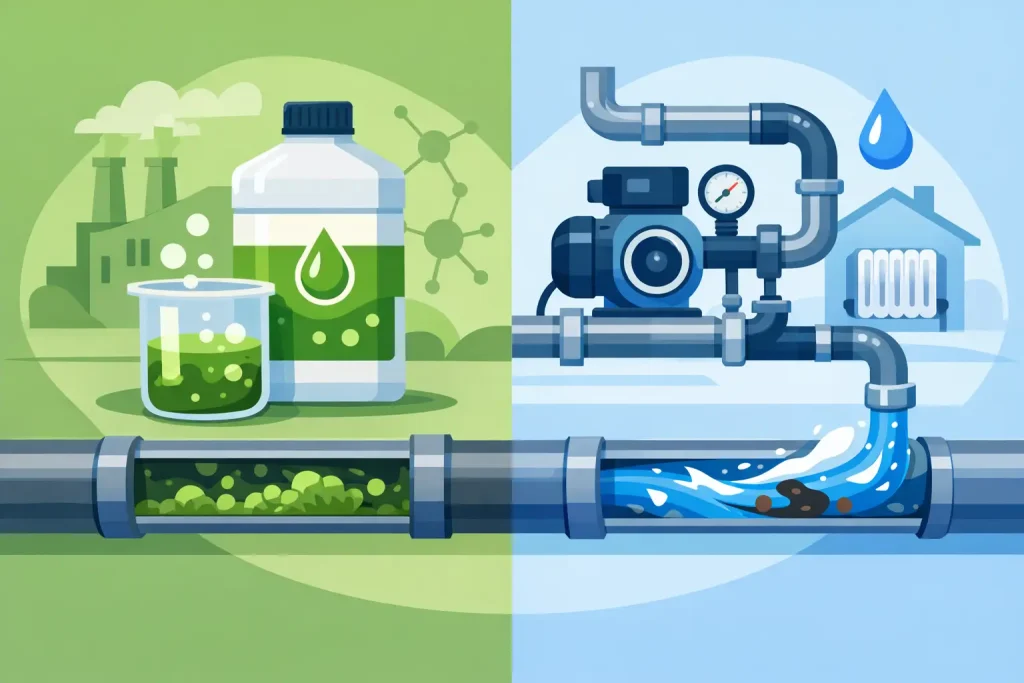
The practical difference is the level of cleaning and the method used to remove debris. A chemical clean relies on the system’s normal circulation, followed by draining and flushing. A powerflush combines cleaning chemicals with dedicated equipment to move water through the system more forcefully and methodically.
Neither option is automatically better. A lightly contaminated, well-circulating system may respond very well to a chemical clean. Putting it through an unnecessarily aggressive clean would add cost without a clear benefit. On the other hand, a system with black water, recurring cold spots and blocked components may need more than a basic chemical treatment.
The condition of the boiler also matters. Sludge can restrict flow through the heat exchanger, increase strain on the pump and contribute to overheating or boiler lockouts. Cleaning may help protect a working boiler, but it will not repair a damaged heat exchanger, a failed pump, a stuck valve or an unrelated combustion fault.
Signs your heating system may need cleaning
One symptom alone does not always prove that sludge is the cause. For example, a radiator that is cold at the top may simply need bleeding, while one that is cold at the bottom is more commonly affected by sludge. A careful inspection avoids guessing.
Common signs that justify a heating water quality check include:
- Radiators that stay cold or have cold areas despite being bled
- Black, brown or murky water when a radiator is drained or bled
- Boiler kettling, banging or unusual circulation noises
- A pump that is noisy or has failed more than once
- Frequent boiler overheating, low-flow or circulation-related fault codes
- New radiators heating poorly soon after installation
- Little or no inhibitor protection in the system water
Older systems can be more prone to corrosion deposits, especially if they have been repeatedly drained and refilled without inhibitor being restored. Oxygen entering the heating water encourages corrosion, and the resulting magnetite can gradually collect in radiators, pumps, valves and boiler components.
When a chemical clean is likely to be enough
A chemical clean may be the right recommendation where the system is generally heating the home evenly, water quality is only moderately poor and there is no evidence of major restriction. It is also often appropriate as part of planned maintenance after certain repairs or alterations.
The best outcome depends on carrying out the full process. The cleaner needs time to work, the dirty water must be removed properly, and the system should be refilled with clean water and a suitable inhibitor. If inhibitor is skipped, corrosion can begin again and the benefit of the clean may be short-lived.
For many households, this measured approach gives good value. It addresses developing contamination without automatically moving to the most extensive option.
When a full powerflush may be justified
A powerflush becomes more worthwhile when contamination is clearly affecting performance or reliability. This might be a property where several radiators are badly restricted, the system water is very dirty, or a boiler replacement is being considered after years of neglected heating maintenance.
Some boiler manufacturers may require evidence that a system has been cleaned before a new boiler is fitted, particularly where there is visible sludge. That is understandable. Installing a new boiler onto a dirty old system can send debris straight into the new heat exchanger and potentially create avoidable problems from the start.
However, a powerflush is not a cure-all. Very old radiators, weakened joints or failing valves may reveal existing issues during any cleaning work. A thorough engineer should explain that possibility beforehand, inspect the system carefully and never promise that cleaning alone will resolve every fault.
The finishing steps that protect your boiler
Whether the job is a chemical clean or a more intensive system flush, the work should not finish when the water runs clearer. The system needs to be refilled, vented and checked for correct pressure and circulation. Radiators should be balanced where required so heat is distributed more evenly around the home.
Adding inhibitor is essential. This protective chemical helps reduce future corrosion and scale formation inside a sealed central heating system. The concentration should be checked rather than assumed, particularly after a drain-down.
A magnetic filter is also a worthwhile consideration for many systems. Installed on the return pipe to the boiler, it captures magnetic debris before it reaches sensitive boiler parts. It is not a replacement for cleaning a heavily contaminated system, but it is a practical layer of ongoing protection. The filter must then be cleaned during annual boiler servicing.
Choose an assessment, not a sales pitch
Before agreeing to work, ask what has been found in your system water, why the recommended method suits your system and what steps are included after the clean. You should also be told if a fault is unlikely to be resolved by flushing alone.
At Boiler-Serv, the focus is on detailed inspection and clear advice, not a one-size-fits-all answer. A properly maintained heating system is more likely to heat evenly, run efficiently and avoid preventable wear on costly boiler components.
If your radiators are slow to warm, your boiler is making unfamiliar noises or the system water looks dirty, arrange a professional check before the problem develops into a breakdown. The right cleaning method should leave you with more than cleaner water – it should give you confidence that your heating is being looked after properly.