
How to Balance Radiators at Home Properly
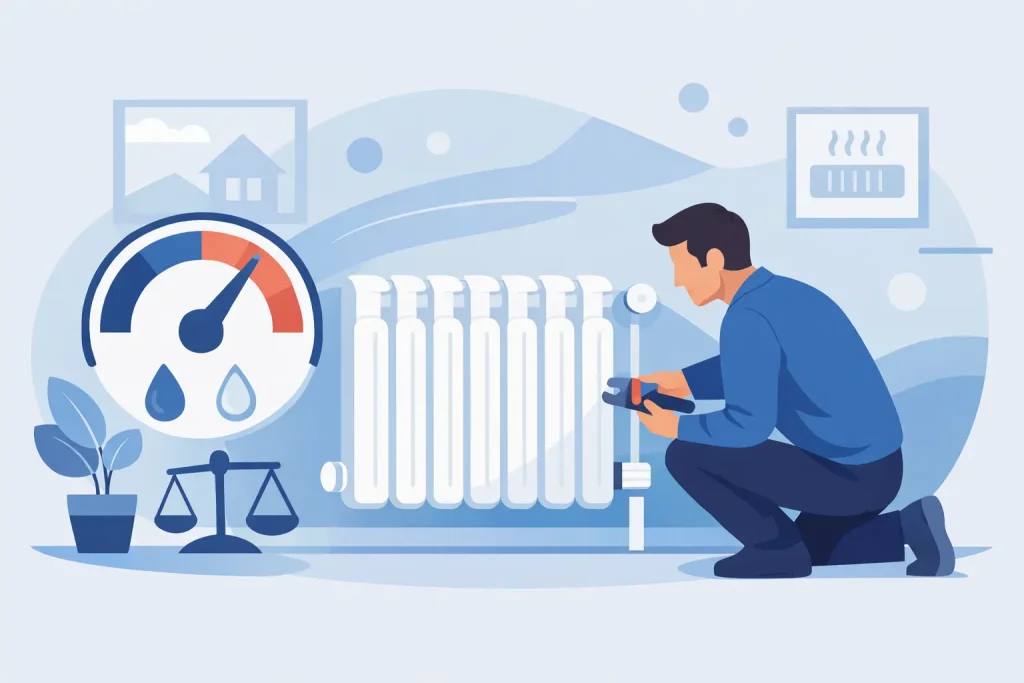
If one bedroom is roasting while the living room never feels properly warm, the issue may not be your boiler. Learning how to balance radiators at home can help heat reach each room more evenly, reduce the temptation to keep turning up the thermostat, and make your heating system feel more responsive.
Radiator balancing is a practical adjustment to control how quickly hot water flows through each radiator. Radiators closest to the boiler often heat first and take more than their share of the flow. By slightly restricting those radiators, more heat can travel around the system to rooms further away. It is a careful job rather than a complicated one, and patience makes a real difference.
What balancing radiators actually does
Balancing is often confused with bleeding, but they solve different problems. Bleeding removes trapped air from a radiator, usually when the top stays cold while the bottom is warm. Balancing adjusts the water flow through radiators that are heating, but doing so at different speeds.
A balanced system should allow rooms to warm up at a more even rate. It will not make an undersized radiator larger, cure a failing boiler, or clear sludge from blocked pipework. If a radiator is cold at the bottom, has persistent cold patches, or needs bleeding repeatedly, there may be a separate circulation or system-cleanliness problem to investigate.
For many homes, balancing is worthwhile after fitting new radiators, changing a pump, carrying out heating repairs, or noticing that distant rooms have become noticeably slower to warm.
Before you balance radiators at home
Start with a simple check. Turn the heating on from cold, open all radiator thermostatic valves fully, and walk around the property after 10 to 15 minutes. Make a note of which radiators become hot first and which rooms lag behind. The quickest radiators are often closest to the boiler, but pipe routes do not always follow the most obvious path.
You will need a radiator valve key or adjustable spanner, depending on the valve caps fitted, plus a small notebook or mobile phone to record adjustments. Two clip-on pipe thermometers can make the work more accurate, although they are not essential for a basic balance. Keep a cloth nearby in case a valve cap or bleed point releases a small amount of water.
Do not remove the boiler casing or alter boiler controls beyond normal user settings. Any work on gas appliances, internal boiler components or safety controls must be left to a Gas Safe registered engineer. Balancing is carried out at radiator valves and should not involve interfering with the boiler itself.
Identify the two valves on each radiator
Most radiators have two valves. One is usually a thermostatic radiator valve, often called a TRV, with a numbered dial. This lets you set the room temperature. The other is the lockshield valve, normally hidden beneath a plain plastic cap. The lockshield is the valve used for balancing because it controls the flow more precisely.
Some older systems have manual valves on both sides. In that case, use the valve that is normally left under a cap as the lockshield. Take photographs before changing anything, particularly if you are unsure which valve is which.
How to balance radiators at home step by step
Begin with the heating switched off and allow the radiators to cool. Set every TRV to its highest setting so it will not close while you work. Remove the lockshield caps carefully. They normally pull off, but some may have a small retaining screw.
Turn each lockshield valve clockwise until it gently closes. Do not force it. As you close each one, count the number of turns and record it. This gives you a useful reference point if you need to return to the previous setting.
Next, open every lockshield fully by turning it anti-clockwise. Once they are all open, turn the heating back on and let the system warm from cold. Keep the room thermostat high enough that the boiler continues running while you test the radiators.
The aim is to restrict the radiators that heat up quickest, then gradually allow more flow to those that heat later. Start with the first radiator to warm. Close its lockshield and reopen it by roughly a quarter turn. Leave it for several minutes and see how the rest of the system responds.
Move to the next radiator in the heating order and repeat, opening its lockshield a little more than the previous one. The radiators furthest from the boiler will often need their lockshields more open. There is no universal number of turns because every home has a different pipe layout, radiator size, pump setting and boiler arrangement.
Make small changes only. A quarter turn can have a noticeable effect. Give the system time to settle after each adjustment, particularly in larger properties or homes with several floors. Rushing from radiator to radiator is the most common reason balancing becomes frustrating.
Use pipe temperatures for a more accurate result
For a closer balance, measure the temperature of the two pipes beneath each radiator once the system is properly hot. One pipe carries hot water in and the other returns cooler water to the boiler. Adjust the lockshield until there is a sensible temperature drop across each radiator.
Many domestic systems are balanced around a drop of roughly 10 to 12°C, but the ideal figure depends on the boiler, system design and controls. Modern condensing boilers may be set up differently, and chasing one exact number without knowing the appliance settings can be counterproductive. The practical goal is consistent heat around the home, with a clear but not excessive difference between the flow and return pipes.
If you do not have thermometers, use your hand cautiously near, not directly on, the pipes. You should be able to feel that the inlet pipe is hotter than the return pipe. Never rely on touch for precise adjustment, as radiator pipework can be hot enough to cause burns.
Check the result in normal use
Once every radiator is heating, refit the lockshield caps and return the room thermostat to its usual setting. Set each TRV for the room it serves rather than leaving them all at maximum. Bedrooms often suit a lower setting than living areas, while halls and kitchens may need less heat due to movement or cooking.
Then observe the system over the next day or two. A balanced system should warm the main rooms more evenly without the nearest radiators becoming hot long before the rest. You may need one or two further small adjustments as the weather changes or as your household uses different rooms.
Avoid repeatedly turning lockshields back and forth once you have a good result. These valves are not intended for day-to-day temperature control. Use the thermostat and TRVs for normal comfort adjustments.
When balancing will not solve the problem
Balancing works only when hot water can circulate properly. If one radiator remains cold while others are hot, first check that both valves are open and the TRV pin is not stuck. A stuck pin is common after the heating has been off over summer and may need freeing carefully.
Call a heating engineer if several radiators are cold at the bottom, the boiler pressure keeps dropping, radiators need frequent bleeding, there are banging or gurgling noises, or the boiler cycles on and off unusually quickly. These signs can point to sludge, air ingress, a failing pump, a blocked filter, an expansion vessel issue, or another fault that valve adjustment cannot correct.
Properties with older heating systems may benefit from a proper system inspection before balancing. Cleaning the system, fitting or servicing a magnetic filter, and checking pump performance can protect the boiler as well as improve heat distribution. We do not cut corners by treating poor circulation as a simple radiator-valve issue.
A carefully balanced system is one of the quieter signs that your heating is being looked after: each room warms as it should, the boiler is not working harder than necessary, and your family can stay comfortable without constantly chasing the thermostat. If adjustments do not produce that result, Boiler-Serv can assess the wider heating system and identify the cause properly.